Within the intensely competitive arena of contemporary pro-level drifting, podium finishes is no longer purely a function of raw horsepower or pilot aggression. Conversely, it has evolved into a intricate discipline which requires a meticulous blend of picking a time-tested chassis, arming it with the correct competition components, and, most importantly, grasping its real-time behavior on the course through advanced suspension tuning applications. This exhaustive manual acts as your roadmap from the very first concept of a project car all the way to the last engineering-refined adjustments that transform a strong machine into a consistent winner. We will delve deep into the precise engineering of vehicle alignment optimization, showing how a state-of-the-art drift tuning app like GripDial eradicates guesswork and delivers unparalleled visibility into your car's real-world performance.
The cornerstone of any successful drift car is, undoubtedly, the base vehicle itself. Several platforms have earned renowned reputation within the international sliding culture due to their inherent weight distribution, durable construction, and the immense availability of specialist components available. Picking the optimal platform is the primary and most crucial selection a driver will make. To illustrate, the the E36 generation BMW is commonly accepted as among the finest overall drift cars of all time. Its near-perfect balanced front-to-rear weight, combined with a rear-wheel-drive setup and robust six-cylinder powerplants, establishes a chassis that is both easy to handle for newcomers and extremely competitive in the hands of a expert competitor. The successor of this lineage, the BMW E46 platform, improves on these strengths with a even more sophisticated chassis, increased wheel track for enhanced confidence, and even increased lock straight from the OEM. A different formidable platform in the professional scene is the C6 generation Corvette.
This V8-powered sports car offers a unique combination of benefits to the sideways world, featuring a lightweight alloy chassis, a backwards-positioned gearbox and differential unit that helps create an ideal weight distribution, and the tremendous torque of a big LS V8 motor. This fusion makes it an complete weapon on track, able of initiating and sustaining long slides with relatively effortless use of power. For drivers seeking outstanding performance per dollar, the Nissan 350Z rises above as a excellent choice. It is delivered from the factory with a rigid platform, a competent OEM limited-slip differential, and the responsive VQ35DE motor that delivers sufficient performance for practicing and progressing in the activity. Its follow-up, the Nissan 370Z, offers further improvements in structural rigidity, handling precision, and peak powerplant output, cementing its place as a favorite choice among competitive drivers. Further legendary platforms that deserve mention include the nimble Wankel-engined FC generation RX-7, the ever-present Nissan S13, the American Ford SN95, the electronic-equipped E90 3 Series, and the tiny yet surprisingly engaging and instructive MX-5 Miata. Every single one of these cars provides a different set of attributes, challenges, and potentials, but they all share the fundamental elements required to become a capable drift machine.
However, choosing the right chassis is only the first step. To release the full potential of every of these cars, significant modifications to the steering geometry and damping and springing systems are completely non-negotiable. This is where the world of specialist tuning components becomes critical view. The one most transformative improvement for a serious drift car is the integration of a maximum-angle steering angle kit. These sophisticated kits, like those developed by performance brands like SLR Speed, are designed to dramatically enhance the chassis's available steering angle. A factory street car is extremely constrained in how far its front wheels can rotate, a engineering compromise for on-road operation. In sliding, but, maximum countersteering is constantly needed to catch and sustain a drift. An angle kit replaces the stock hubs, rod ends, and sometimes control arms with pieces that enable the wheels to attain steering lock beyond 70 or even 80 °, versus a average factory setting of around 40 to 50 °.
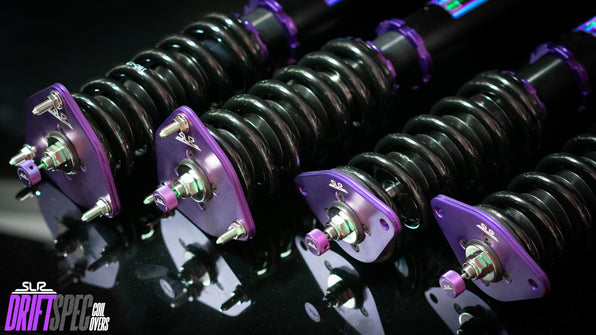
This tremendously expanded capability provides the pilot with significantly greater authority during a drift, allowing it to be far simpler to begin a slide, sustain it through a long turn, and change seamlessly from one direction to the other. The difference in drivability is absolutely profound. Combined with a correctly selected modification is the just as essential enhancement to the vehicle's spring and damper setup. Off-the-shelf or including premium road adjustable suspension are simply not intended for the specific and brutal needs of competitive oversteer. A dedicated set of coilovers is paramount. These specific dampers have specific valving and spring rates that are tuned for the extreme weight transfer that is characteristic of sliding. When a pilot starts a drift, the car's weight is transferred rapidly to the front of the bend. Correct drift-spec coilovers manage this transfer in a controllable fashion, permitting the vehicle to find its balance promptly and giving the driver clear feedback through the controls and seat. They also allow for precise setting of stance, shock absorber firmness, and cross-weight, which are all integral parts of fine-tuning the chassis's dynamics to a specific venue or piloting style. Together, a high-quality drift angle kit and a expertly chosen system of drift-spec coilovers are the absolute hardware foundation upon which all future optimization is based.
Once the fundamental components is in place, the next critical step in the build is the detailed tuning of the vehicle's wheel angles. This is the realm of car suspension tuning, a procedure that can seem daunting to the uninitiated but is, in fact, the key to turning a assembly of fast components into a cohesive and controllable whole. The most debated parameter of tuning for drifting is undoubtedly camber angle. Wheel camber is the angle of the rim relative to the upright line when looked at from the front of the chassis. When the upper part of the tire is tilted towards the car, this is called camber-in. In drifting, an inward tilt on the steering tires is universally employed and is seen as critical. The reason is fundamentally tied to vehicle dynamics.
When a car is going around a bend at extreme slip angles, the frame tilts toward the outside of the corner. This chassis roll makes the outer front wheel to diminish its best contact patch with the tarmac. By introducing negative camber, the tire is pre-leaned to account for this roll. As the chassis tilts into the bend, the outside front tire flattens out with the road surface, maximizing its grip at the exact moment when it is needed most for control. Typically, front camber settings for a dedicated drift car range from approximately -3 degrees to as extreme as -5 degrees or even greater, based on the details of the chassis setup, compound type, and operator preference. The back tires also use negative camber, but the settings are usually more modest and more nuanced than the front. Overly aggressive camber at the rear can cause the vehicle to extremely prone to oversteer and challenging to control on acceleration use, as it reduces the usable tire footprint of the driving tires during forward acceleration. Hence, rear camber settings are commonly in the range of -1 degree to -3 degrees, achieving a careful balance between giving enough lateral grip to aid in starting and sustaining the slide while still keeping good traction for exiting the turn. Camber is only one element of the more complex alignment puzzle, which also involves toe angle, caster, and suspension-induced steering modification.
Toe setting describes the angle of the wheels when looked at from above. Inward toe means the leading edges of the wheels are closer together than the trailing edges, while negative toe means the opposite. For sliding, a modest amount of front toe out is frequently run to sharpen the turn-in directional response, making the car feel more nimble and ready to begin a slide. Rear axle toe is typically set to neutral or a incredibly slight amount of toe-in to encourage straight-line stability under throttle. Caster is the frontwards or aft inclination of the steering axis when observed from the lateral of the chassis. Positive caster increases feedback and stability solidity, and it furthermore adds to negative camber gain during cornering, which is highly advantageous. Setting these parameters is a intricate interplay where a change to one parameter can and often will impact the remaining parameters. The conventional process for setting a vehicle's suspension geometry for drifting has for a long time been a time-consuming process of guesswork and adjustment. A pilot or engineering group would introduce a car alignment tuning modification based on a hunch, drive the chassis on track, depend on the driver's subjective feel and feedback, and then make another change. This process would continue over and over until the chassis felt "acceptable" or the available testing period ended. This system is not just exceptionally wasteful in terms of man-hours and tires, fuel, and parts, but it is additionally fundamentally imprecise.
Pilot sensation is a notoriously subjective data source, influenced by countless elements such as fatigue, varying track surfaces, temperature, and just the mindset of the operator on that particular day. What feels "loose" on one run might feel "pushing" on the following lap, leading to contradictory data and frustrating adjustments. This long-standing limitation in chassis setup is specifically where contemporary technology has made its mark to revolutionize the landscape.
The rise and integration of specialized vehicle dynamics tools has ushered in a completely new age for engineering and optimizing high-performance drift cars. This new generation of tools, represented by cutting-edge solutions like data acquisition tools, work by directly capturing the live dynamic behavior of the vehicle as it is piloted on the track. As opposed to relying on personal feedback, these tools acquire objective data on critical factors such as suspension travel, wheel speed, acceleration forces, wheel angle, and accelerator and brake pedal application. This raw telemetry is then processed by advanced algorithms that can plot and decode the information in a clear format. For the first time, engineers and crews can visualize specifically what the chassis is exhibiting at every millisecond of a drift. This capability changes the whole alignment optimization workflow. Imagine the aforementioned challenge of optimizing the front axle negative camber for a specific chassis. As an alternative to introducing a change from -3 degrees to -3.5 degrees and then driving multiple laps to try and "feel" a difference, a suspension tuning tool can provide immediate and clear data. The application can display visually how the suspension's contact patch is behaving during the critical stages of a slide: turn-in, sustain, and transition. It can demonstrate if the present value is enabling the steering tire to maintain optimal contact or if the compound is working inefficiently on its outside edge.
The software can after analysis provide data-driven recommendations for modification. drift suspension tuning guide Perhaps the telemetry shows that the tire is still overworking its edge at -3.5 degrees of negative camber, indicating that an increase to negative camber, say -4 degrees, might be beneficial. Alternatively, the information might indicate that the tire is failing to achieving heat or that the inner shoulder is wearing excessively, which could point to that there is overly aggressive angle and a small lessening back to -3.2 degrees would be better optimal. This standard of accuracy and practical intelligence was simply impossible in the days of solely seat-of-the-pants tuning.
The effect of using a dedicated drift telemetry system goes much further than just setting camber. It becomes an priceless coilover setup tips that is customized to your exact vehicle. When adjusting the shock absorber settings on your suspension, instead of depending on general advice or replicating another driver's settings, you can employ the telemetry to observe how the car is performing in response to your changes. The tool can graph the suspension travel data over a lap, showing if the coilovers are handling the weight transfer properly or if they are causing the chassis to bounce uncontrollably after a transition. It can assist in pinpointing issues like hitting the bump stops or excessive extension, enabling you to apply data-backed adjustments to spring preload, damping settings, or ride height. This process translates just as well to the detailed art of car alignment tuning. Beyond camber, the system can provide insight into how changes to toe and caster are affecting the vehicle's stability during various parts of a lap. For instance, it can assist you to find the ideal amount of front toe out for your suspension engineering particular steering setup and driving style by measuring the response time of turn-in response and the consistency of the car at full steering angle. This transforms the software an extremely effective vehicle dynamics manual that is actively updated by the live dynamics of your personal vehicle on the track. It elevates the whole endeavor from a dark art into a scientific optimization process.
Additionally, the application of a system like data acquisition is in no way restricted to expert engineers with large budgets. For the grassroots competitor, it serves as an amazing equalizer. It effectively provides the builder with the insight of a expert dynamics engineer without needing the typical expense. It accelerates the learning curve by giving clear directions to questions that would normally take years of experimentation to answer. A tuner can see how their particular chassis reacts to specific adjustments, gaining a deeper knowledge of vehicle dynamics in the journey. It also makes accessible high-level performance tuning concepts, enabling anyone with the drive to optimize their machine to do so in a efficient and effective way. This is notably important in a discipline like oversteer competition, where setup knowledge has traditionally been a highly secretive commodity among elite crews. Now, that knowledge can be in the garage of every dedicated driver.
In the final analysis, the process to building and tuning the perfect high-performance drift car is a multi-stage project that perfectly blends proven engineering knowledge with cutting-edge data tools. It starts with the wise pick of a proven chassis, then enhanced by the integration of non-negotiable competition parts like drift-spec drift angle kits and properly valved drift-spec coilovers. The process then advances into the detailed realm of car suspension tuning, where parameters like camber, toe, and caster angle are precisely set to suit the car's modified geometry and the pilot's specific style. The final step, and what really distinguishes the contemporary approach from the traditional methods, is the use of a advanced vehicle dynamics tool. This tool eradicates the approximation and waste of purely seat-of-the-pants adjustment by delivering objective, actual telemetry on how the car is truly behaving. It functions as an indispensable diagnostic aid, a comprehensive alignment optimization handbook, and a master performance analyzer. Together, this integrated approach leads to that every element of the competition vehicle—from the pick of the chassis to the final adjustment on the coilover—is refined for peak success on the track. It represents the full maturation of the discipline of oversteer driving, connecting raw driving skill with surgical chassis dynamics to forge the perfect dominant vehicles imaginable.